A well-prepared business valuation is a powerful planning tool, one that supports smarter decisions, stronger negotiations, and long-term success. At Froehling Anderson, we help business owners understand what drives value and how to protect and grow it. Here’s a practical overview of the business valuation basics every owner should know.

What Is Business Valuation?

Business valuation is the process of determining the economic value of a company based on financial performance, assets and liabilities, market conditions, and future earning potential. It goes far beyond revenue alone.

A professionally prepared valuation provides insight into:

  • Your company’s financial health
  • Its competitive position within your industry
  • The risks and opportunities that impact long-term value

When done correctly and in accordance with American Institute of Certified Public Accountants’ Statement on Standards for Valuation Services No. 1 (SSVS No. 1), a valuation delivers credible, defensible results that stand up to scrutiny from buyers, lenders, investors, and regulators.

Why Business Valuation Matters

A business valuation isn’t just for exit planning. Business owners often need valuations for many reasons, including:

  • Selling or merging a business: Buyers and investors rely on fair market value.
  • Estate and succession planning: Valuations support tax planning and smooth ownership transitions.
  • Financing and lending: Banks often require valuations when underwriting loans.
  • Strategic growth planning: Understanding value helps guide expansion, reinvestment, or restructuring decisions.
  • Ownership or partnership changes: Ensures fairness and transparency.

In short, knowing what your business is worth puts you in a stronger position no matter what the future holds.

Common Business Valuation Methods

While every business is unique, most valuations rely on one or more of the following approaches:

Asset-Based Approach

This method calculates value based on the company’s fair market value of assets minus liabilities, including both tangible and intangible assets. It’s commonly used for asset-heavy businesses or in liquidation scenarios.

Income Approach

The income approach focuses on future earning potential, often using discounted cash flow (DCF) analysis. This method is widely used for profitable, ongoing businesses and emphasizes cash flow, risk, and growth expectations.

Market Approach

The market approach compares your business to similar companies that have sold recently, using market data and valuation multiples. This approach works best when reliable industry data is available.

At Froehling Anderson, our valuation professionals evaluate which methods are most appropriate based on your industry, size, financial structure, and objectives.


Common Methods to Value a Business

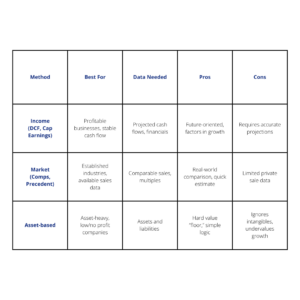
A variety of business valuation methods exist, but most fall into three primary approaches.

Business Valuation Chart

Chart is from Business.com

Key Factors That Influence Business Value

Several variables can significantly impact what your business is worth, including:

  • Financial performance: Revenue consistency, profitability, and cash flow.
  • Industry trends: Growth potential, competition, and economic stability.
  • Customer concentration: A diversified customer base often reduces risk.
  • Management and leadership: Strong, experienced teams add value.
  • Economic conditions: Interest rates, inflation, and market demand all play a role.
  • Intangible assets: Brand reputation, proprietary processes, and intellectual property are often undervalued but critical.

Understanding these drivers allows owners to proactively strengthen value not just measure it.

Common Business Valuation Mistakes to Avoid

Business owners often make avoidable mistakes when it comes to valuation, such as:

  • Waiting until the last minute to obtain a valuation
  • Relying on unqualified or informal valuation sources
  • Overlooking the importance of clean, accurate financial statements
  • Ignoring current market conditions and industry data
  • Undervaluing intangible assets
  • Failing to consider tax implications
  • Treating valuation as a one-time event rather than an ongoing planning tool

A proactive approach helps avoid surprises and puts you in control.

When Should You Consider a Business Valuation?

You may want to obtain a valuation if you are:

  • Preparing to sell, merge, or acquire a business
  • Planning for ownership or partnership changes
  • Raising capital or entering a major financing arrangement
  • Engaging in estate or succession planning
  • Navigating disputes or strategic restructuring
  • Periodically reviewing value as part of long-term planning

Many owners benefit from updating valuations every few years, even when no transaction is imminent.

How Froehling Anderson Approaches Business Valuation

At Froehling Anderson, we take a thoughtful, compliant, and client-focused approach to business valuation. Our team combines technical valuation expertise with deep understanding of our clients’ industries and goals.

As trusted accountants located in Minneapolis and St. Cloud, Minnesota, we:

  • Follow SSVS No. 1 standards and current IRS and regulatory guidance
  • Leverage accurate financial data and industry benchmarks
  • Collaborate closely with business owners and advisors
  • Translate complex valuation concepts into clear, actionable insights

Whether you’re planning for growth, succession, or a future transaction, our goal is to help you understand not just what your business is worth but why.

Final Thoughts

Business valuation isn’t just a number on a report. It’s a strategic tool that supports smarter decisions, stronger negotiations, and long-term security. With the right guidance, valuation becomes an opportunity, not a stress point.

If you’re a business owner, Froehling Anderson is here to help. Our experienced team of CPAs can guide you through the valuation process with clarity, confidence, and care.


Disclaimer: This content is for informational purposes only and does not constitute legal, tax, or audit advice. Please consult with your CPA for guidance tailored to your situation.