We are moving, effective July 27, 2026. Our employees will be remote from July ​10-27, 2026, and will still be accessible via email, Zoom, and phone.

Business decisions shouldn’t rely on guesswork. That’s where financial forecasts and projections come in. Froehling Anderson helps organizations use these tools to confidently plan for the future; we translate financial data into real-world strategy.

What Are Financial Forecasts and Projections?

Both financial forecasts and projections are considered prospective financial statements under AICPA Attestation Standards Section 301, meaning they are forward-looking and built on assumptions. But they are not interchangeable.

Financial Forecast

A forecast estimates financial performance based on what you believe will happen based on current data, trends, and planned actions.

Forecast = “Based on what we know today, here’s what we expect.”

Typical uses of a forecast:

  • Annual budgeting and planning
  • Communicating expectations to investors or lenders
  • Predicting revenue, expenses, and cash flow in the near term

Forecasts are especially helpful for companies with steady, predictable performance.

Financial Projection

A projection models possible outcomes based on hypothetical assumptions.

Projection = “What would happen if we…?”

Projections are used to:

  • Evaluate future or theoretical scenarios
  • Explore new markets, products, or strategic decisions
  • Analyze long-term or transformative initiatives

Projections provide flexibility and are ideal when uncertainty or change exists.

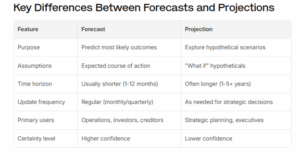
Key Differences Between Forecasts & Projections

A chart on the key differences between forecasts and projections.

Table from Abacum.

When Your Business Should Use Each Tool

Use Forecasts when you want to:

  • Plan annual budgets
  • Manage cash flow expectations
  • Communicate financial expectations to stakeholders
  • Align performance with organizational goals

Use Projections when you want to:

  • Evaluate long-term strategy
  • Analyze mergers, acquisitions, or new markets
  • Model new product or service launches
  • Assess best-case / worst-case scenarios

Real-World Example

Forecast Example:
After deciding to finalize the expansion, leadership needs a realistic view of next year’s numbers; revenue, expenses, and cash flow. With decisions made and direction set, the resulting plan becomes a forecast.

Projection Example:
A manufacturing company is considering expanding into a new Midwest market. Leadership wants to understand potential revenues, staffing needs, and capital investment requirements. Because this is theoretical, the resulting analysis would be considered a projection.

How Froehling Anderson Approaches Forecasts and Projections

Our CPAs go beyond spreadsheets. We help you make informed business decisions.

  • We learn your business and goals
  • We analyze internal performance and external variables
  • We model outcomes to support clarity and confidence

Our advisory team works with business owners and CFOs in manufacturing, distribution, construction, professional services, nonprofit, real estate, and high-net-worth individuals. Whether you need a financial forecast to guide budgeting or a projection to evaluate a strategic decision, we tailor our approach to your needs.

Froehling Anderson combines:

  • Deep industry expertise
  • Local market knowledge
  • Data-driven financial modeling

You don’t just get numbers, you get insight.

Why It Matters

When done correctly, forecasts and projections:

  • Reduce financial uncertainty
  • Support better communication with banks and investors
  • Help plan staffing, purchasing, and capital investments
  • Improve confidence when making major decisions

When done with Froehling Anderson, they become a strategic advantage.

Ready to Plan Ahead with Confidence?

If you’re unsure whether your business needs a forecast or projection, our advisory team can help you determine the right approach. Our trusted and highly experienced team has been helping businesses make decisions with confidence for 79+ years.

Let’s build clarity into your future.


Disclaimer: This content is for informational purposes only and does not constitute legal, tax, or audit advice. Please consult with your plan advisor or CPA for guidance tailored to your situation.